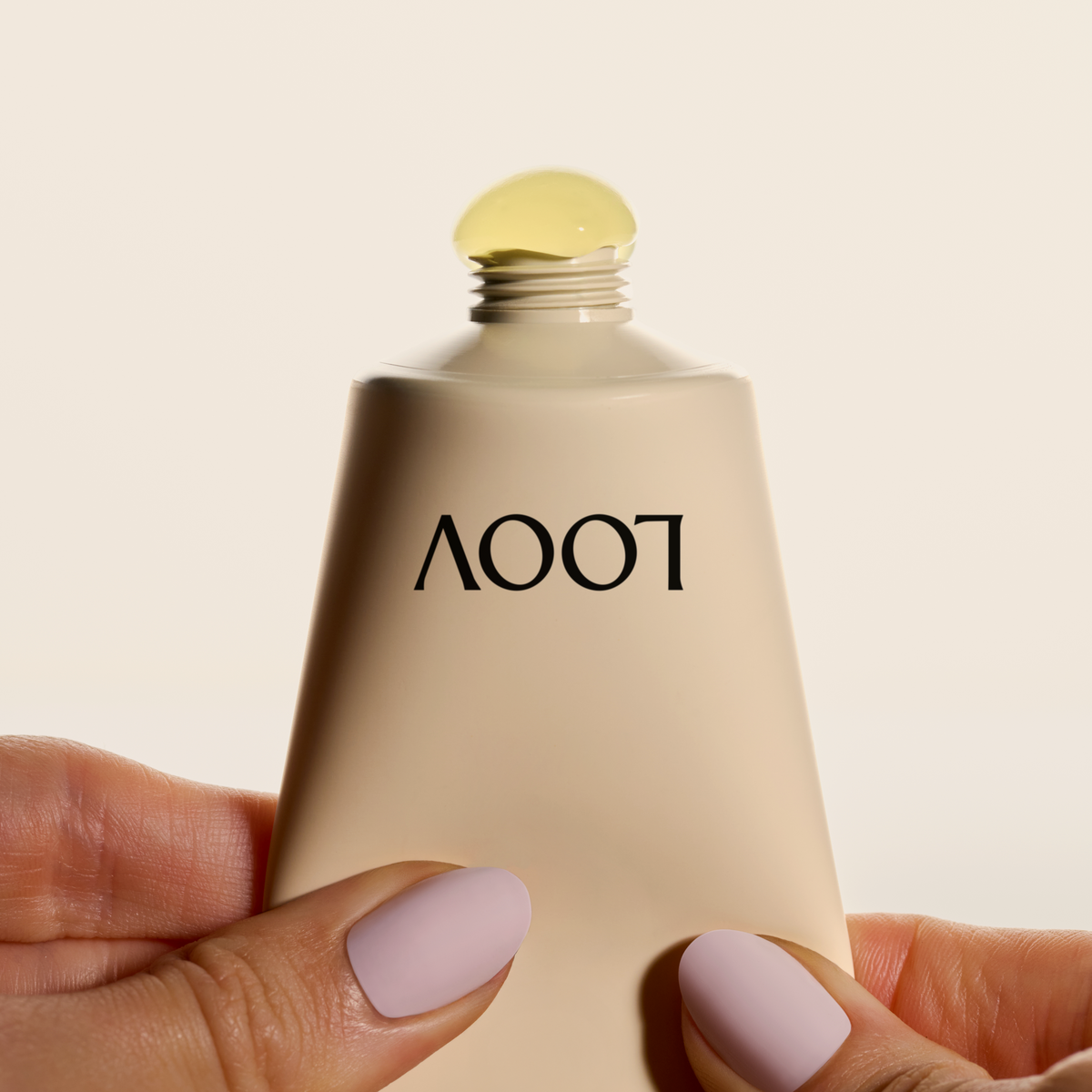
The instruction to reapply sunscreen every two hours is a labeling requirement, not a measurement of how long protection lasts. What actually removes sunscreen from a face is friction, not sunlight. The useful rule is to reapply when the film has been disturbed, or just before you walk into real light, and to do it by pressing product on with a damp sponge rather than dragging it across makeup.
If you want the short version, that is it. Below is where the two hour rule came from, what the research shows about how sunscreen actually leaves a face over a day, and the exact midday method that ruins nothing.
There is a small guilt that arrives at noon. You applied sunscreen at seven. It is now one. Somewhere you absorbed the idea that the protection has expired, and that to restore it you would have to take your face apart and build it again. Set the guilt down. It was never earned.
Where the two hours came from
The instruction to reapply at least every two hours is a labeling requirement. It lives in the United States federal code, at 21 CFR 201.327, and every sunscreen sold here is obliged to print it. It is not a finding. It is a sentence on a bottle.
When the rule was finalized in 2011, manufacturers objected that no data supported the interval. The FDA's own record notes that the American Academy of Dermatology no longer supported a two hour timeframe either. The agency kept the number anyway, reasoning that public education materials already said two hours and that consistency was worth preserving. Of the references it named in defense of the interval, one was a small observational study of beachgoers from 2001. The other was a press release.
The most common explanation offered for the rule, that the filters break down, is contradicted by the regulator that wrote it. In the same document, the FDA stated it had received no data demonstrating that any sunscreen's effectiveness is significantly diminished by photodegradation.
There is a reason for that. Modern filter systems are formulated as systems, each ingredient chosen partly for what it does for the others. Avobenzone on its own is famously light sensitive. Paired with the right stabilizing partner, published photostability testing has it holding around 90 percent of its performance through a dose of ultraviolet equivalent to the better part of a day in high summer. This is ordinary competence in a well built formula, and it is one of the reasons the four filters in Shield were chosen to sit together.
None of which makes protection permanent. It means the clock is the wrong instrument.
What actually takes sunscreen off a face
Friction does. Not sunlight.
Researchers followed outdoor workers through an eight hour day without a single reapplication and measured what remained. Coverage fell about 18 percent by hour two, and about 32 percent by hour eight. The losses were not even. The chin lost the most, around 40 percent, and the skin above the upper lip close to 38 percent. The cheeks, which nobody touches, held.
That is the real picture. Sunscreen does not evaporate on a schedule. It is removed, in patches, by the hand that rests on the chin, the napkin, the phone, the moment of rubbing an eye.
Reapply when the film has been disturbed, not when the clock says so
The morning that makes the midday easy
Most protection is won or lost before you leave the house, and it is lost to quantity, not chemistry.
Sun protection factor is measured in a laboratory at two milligrams per square centimeter. Almost nobody applies that much. In one trial, volunteers applied sunscreen the way they normally do and were then simply asked to go over it a second time. The delivered dose rose from 0.60 to 1.10 milligrams per square centimeter, and the skin they had missed entirely fell from 20 percent to 9 percent.
- Two finger units. Strips along the index and middle fingers, from crease to tip, for face, ears and neck.
- Let it settle. Give it a few minutes on dry skin before anything goes on top.
- Go over it once more. Fifteen to thirty minutes later, before you leave, do a second pass. This is the highest yield thirty seconds of the entire day.
- Then makeup. Sunscreen first, always.
That second pass costs you nothing but the waiting you were doing anyway. It is also markedly easier with something that absorbs quickly and leaves no film to disturb, which is the practical argument for a serum weight sunscreen over a heavy one.
The three questions that replace the alarm
At midday, do not consult the clock. Ask three things.
Have I been in real light since I applied? If your morning was interior office light, away from windows, there is no meaningful exposure to replace. Skip it. If you have been beside a window, driving, or outdoors, continue.
Am I about to be outdoors in the middle of the day? Then apply immediately before you go, not two hours after you last did. Roughly three quarters of a summer day's ultraviolet arrives between nine and three by sun time, which on your phone in daylight saving is closer to ten to four.
Have I swum, sweated, towel dried, or wiped my face? Reapply now, whatever the hour. This is the one trigger that is genuinely evidence based, and it is why water resistance is rated in minutes. Shield is water resistant for eighty minutes, tested.
The technique that ruins nothing
Press. Never drag.
- Dispense onto the back of your hand. Not directly onto the face, where you will be tempted to rub.
- Load a clean, barely damp cosmetic sponge. Damp keeps it from drinking the product.
- Press and lift. Work across the face in quadrants, then deliberately over the chin and the skin above the lip, the two places the workday study found emptiest.
- Do not stop at the face. Ears, the sides of the neck, the chest above a neckline, and the backs of the hands, which age in plain sight and are almost never included.
- Let it sit a minute, then blot. Plain tissue for shine, not powder.
Pressing works because it deposits product without shearing what is underneath. Dragging is what moves foundation, and dragging is what you have been avoiding by not reapplying at all. A sunscreen that disappears rather than sitting on the surface makes this far easier, because there is no white to press into a face that already has makeup on it.
What not to mistake for sunscreen
Powder is a shine control, not a dose. The most generous measurement on record comes from a powder manufacturer's own submission to the FDA: about 0.65 milligrams per square centimeter after more than a minute of brushing, roughly a third of the tested amount. Measurements of ordinary consumer use came in far lower. Applied at those levels, on the standard model, a high number on a powder compact behaves like a very low one. Use it to take down shine. Do not count it as protection.
Setting mists have the same problem in a different form. In testing, an aerosol lost more than half its product to the air at close range. At arm's length from a face, more.
And numbers do not stack. An SPF 20 primer over an SPF 15 foundation is not an SPF 35. Nothing is ever tested that way. What layering genuinely does is add mass and evenness, which is measurably useful, so layer freely. Just count only the sunscreen underneath.
The whole of it
Get the dose right twice in the morning. Then let the day proceed. Reapply when the surface has been disturbed, or just before real light, with a sponge and actual sunscreen.
A daily sunscreen you can press over makeup without a second thought is the one that gets worn. Shield is broad spectrum SPF 45, water resistant for eighty minutes, fragrance free, non comedogenic, and invisible on every skin tone, light through deep, which is what makes a midday reapplication possible at all.
Protection is not a schedule you are failing. It is a film you are keeping.

