Both mineral and chemical sunscreens work mainly by absorbing ultraviolet light, not by blocking it. Zinc oxide and titanium dioxide reflect only about four to five percent of UV and absorb the rest. The real difference is physical form: mineral filters are solid particles that scatter visible light, which is what a white cast is, and organic filters are dissolved molecules too small to scatter anything. Choose on how a formula wears, because application quantity moves real world protection far more than filter type does.
If you want the short version, that is it. Below is where the popular framing goes wrong, what the FDA absorption studies actually found, and what we chose for Shield.
Begin with the words, because the words are wrong
Mineral filters are described as blockers that sit on the surface and reflect ultraviolet away, and organic filters, the ones commonly called chemical, as absorbers that soak it up. It is a tidy division and it is not what happens. Zinc oxide and titanium dioxide reflect somewhere around four to five percent of ultraviolet, which on its own would amount to less than SPF 2. The rest they absorb, by the same fundamental mechanism as the filters they are supposedly opposed to.
So the choice was never between blocking and absorbing. Nearly all of it is absorption. What actually differs is the form the filter takes, and that is where the visible difference on your face comes from.
Why one kind leaves a cast and the other does not
Mineral filters are solid particles. They have to be, to work. Particles of that size scatter visible light as well as ultraviolet, and scattered visible light is what your eye reads as a pale veil. Formulators have spent two decades making those particles smaller and better dispersed, and modern mineral sunscreens are far more elegant than they once were. The physics still sets a floor. On deeper skin, that floor is visible.
Organic filters are not particles. They are molecules dissolved in the formula, sized far below the wavelength of visible light, so there is nothing there to scatter. Light passes through and the skin underneath is simply the skin.
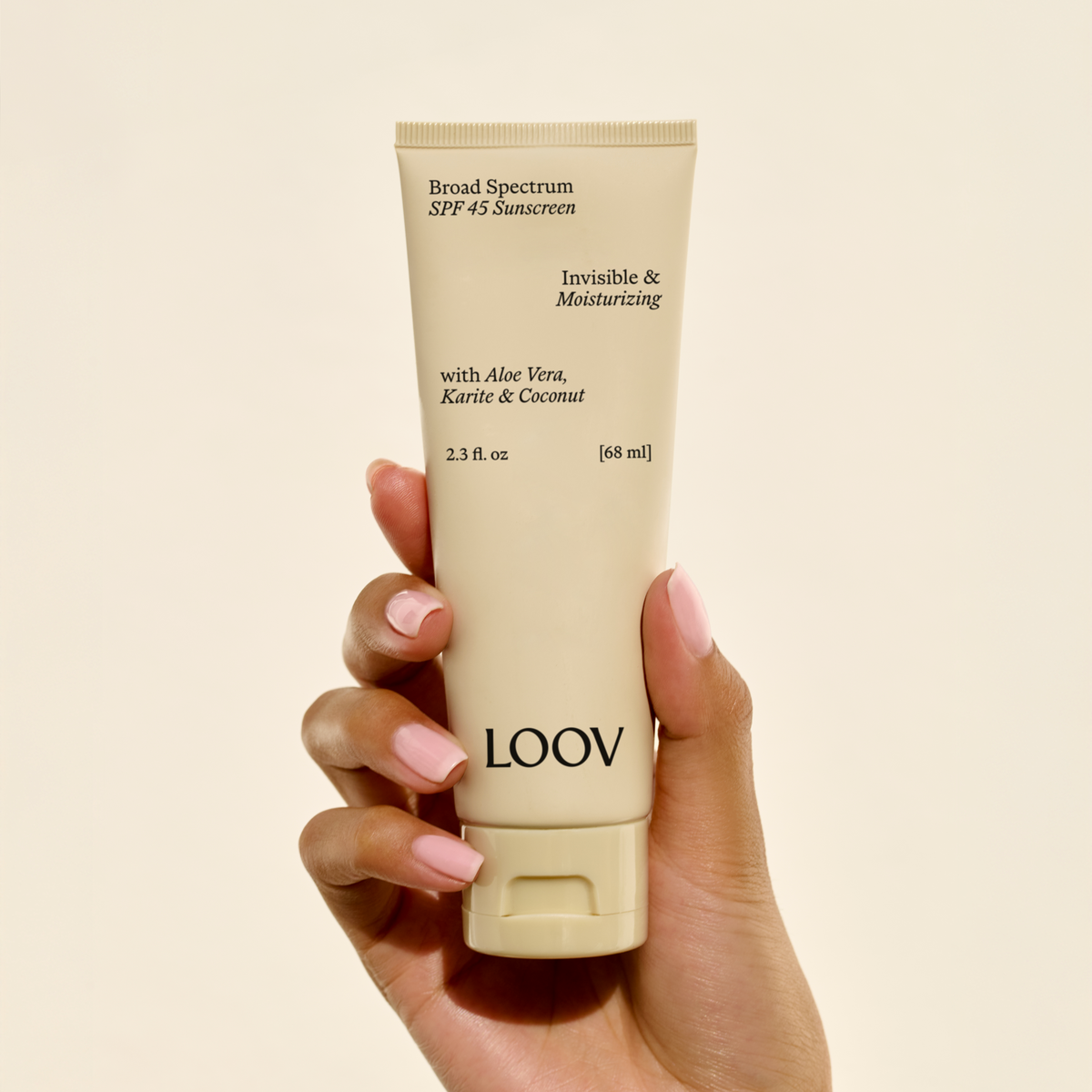
This is the mechanism behind an invisible finish, and it is why Shield is built on an organic filter system. Not as a compromise. As the only route to a sunscreen that disappears on every complexion, light through deep, and wears like a serum rather than a layer.
Nearly all sun protection is absorption. The rest is a question of finish
The safety question, answered directly
In 2019 and 2020, FDA researchers published two trials that produced the headlines still driving this conversation. Volunteers applied sunscreen at the full tested laboratory dose, over most of the body, four times a day for four days. Blood was drawn. Several filters were detectable in plasma above 0.5 nanograms per milliliter.
Two things about that threshold, both of which get lost.
It is not a safety limit. It is the level below which the FDA will waive a long term carcinogenicity study for an unknown compound. Crossing it triggers further testing. It is not a finding of harm.
And the authors, in the papers themselves, wrote that their findings do not indicate that people should stop using sunscreen. Any article that cites those studies without that sentence is not informing you.
The related headline, that the FDA has not classified a number of organic filters as generally recognized as safe and effective, is a statement about missing paperwork rather than discovered danger. The agency's own language is that it does not have enough information to make a positive determination. These ingredients predate the modern data requirements and the dossiers were never filed. That proposal has still not been finalized.
Meanwhile the thing that is not in question, across every major dermatological body, is that daily broad spectrum sunscreen protects skin. The strongest evidence in the field is a randomized trial that followed adults for four and a half years and found measurably less skin aging in the group using sunscreen daily.
What we chose, and what we left out
Shield uses four organic filters: avobenzone, homosalate, octisalate and octocrylene. They are printed on the bottle, as required, and we would rather you read them than take our word for anything.
Two filters carry most of the controversy in this category, oxybenzone and octinoxate. They are the two named in Hawaii's legislation and the two carrying the bulk of the endocrine literature. Neither is in Shield, and neither has ever been.
We will not tell you a sunscreen is reef safe, because the term is unregulated and nobody can honestly certify it. We will tell you what is in the bottle.
The care that matters more than the debate
Sunscreen is a formulation, and formulations age. Heat is what ages them fastest.
So replace it once a year, and do not store it in a car, a glovebox, or the bottom of a beach bag in July. This is true of every sunscreen on the market regardless of filter type. It is quietly the most useful sentence in this article, and almost nobody says it, because it does not sell a second bottle this month.
The same goes for the benzene findings that circulated a few years ago, which are frequently misfiled as a chemical sunscreen problem. They were not. Benzene turned up across mineral and organic formulas alike, in sprays and lotions and gels, and it is a manufacturing contaminant rather than a property of any filter. The defense is fresh product from a traceable supply chain, not a change of filter class.
What actually decides your protection
Not this argument. Quantity.
Sun protection factor is measured at two milligrams per square centimeter. Most people apply a quarter to a half of that and receive a correspondingly smaller fraction of the number on the label. About a third of a teaspoon for face and neck, or two full finger lengths, is the target.
Which means the useful question is not chemical or mineral. It is which one will I actually wear every morning, in the right amount, without thinking about it. A sunscreen you admire and skip protects nothing. That is the entire brief Shield was formulated against: broad spectrum SPF 45, water resistant to eighty minutes, fragrance free, non comedogenic, dermatologist tested, and light enough that wearing it daily requires no discipline at all.
And keep the whole thing in proportion. Shade in the middle of the day, a hat, and sleeves do more than any argument about filters. Sunscreen is one layer of an answer. We would rather say that than pretend otherwise.
A formula worth trusting is one that can be read in full.

